Imagine this: You’re sitting on your rented scooter, the warm wind blowing through your hair, the sun kissing your face, and the breathtaking coastal road of Khao Lak stretching out before you. To your right, the deep-blue ocean; to your left, lush green jungle. That’s pure freedom—and a dream come true for many Thailand vacationers! But wait—before you dive headfirst into this adventure, there are a few things you absolutely need to know. Because while Thailand’s roads are beautiful, they also come with risks, especially if you’re not familiar with the local rules and laws. I’ll take you by the hand and guide you through the jungle of driver’s license requirements, traffic rules, and important insider tips to make sure your trip is unforgettable—and safe.
The great freedom on two or four wheels: Your Thailand adventure awaits!
Khao Lak and its surroundings are perfect for exploring on your own. Whether it’s hidden beaches, local markets, or impressive waterfalls in the national park—with your own vehicle, you’ll have the flexibility to discover spots that many tourists never see. A scooter is often the top choice for solo travelers or couples, as it’s maneuverable and affordable. Families or travelers with more luggage might prefer the convenience of a rental car. No matter what you choose, preparation is the key to a relaxing vacation experience.
The Be-All and End-All: Your Driver’s License in Thailand – Don’t Cut Corners!
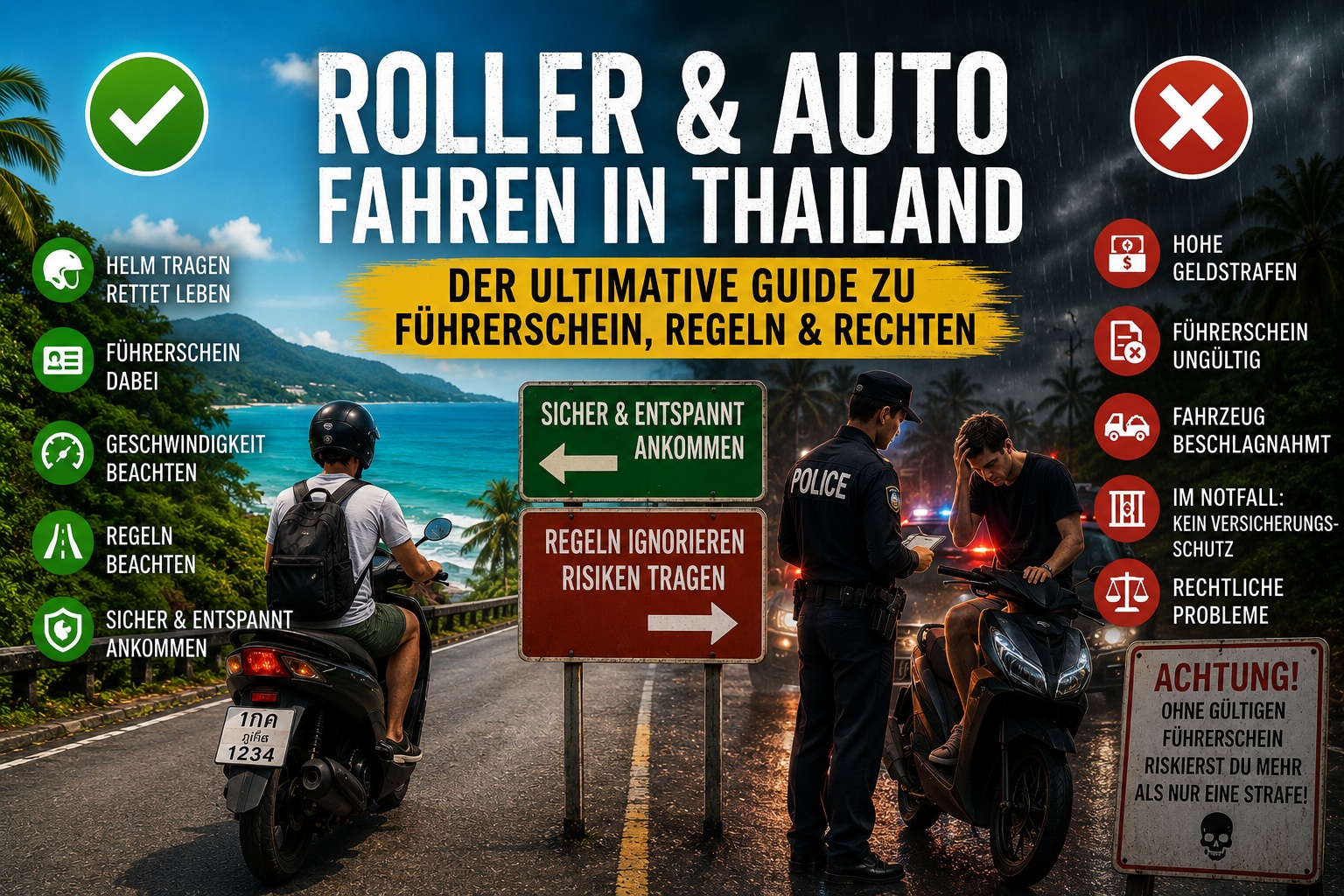
This is the most important point in this guide, and I can’t stress it enough: Take Thailand’s driver’s license rules seriously! They’re different from those in Germany, and ignorance can be costly—and, in the worst case, life-threatening.
The German Class B Driver’s License—Beware of the Trap! You got your driver’s license (Class B) in Germany and think that means you’re allowed to ride a scooter in Thailand too? Far from it! This is the most common and dangerous misconception. Most scooters rented here have an engine displacement of 110cc to 125cc. In Thailand, these vehicles are legally classified as motorcycles. This means: To ride them legally, you need a corresponding motorcycle license class—either A1 or A—which must be listed on your German driver’s license. Your German Class B driver’s license does NOT cover riding such a scooter in Thailand. Even if you have a moped certification in Germany, it is not valid in Thailand for the typical rental scooters.
The International Driver’s Permit: Your Indispensable Companion (Important: The Right Agreement!) Even if your German driver’s license includes the appropriate motorcycle class, it alone is not sufficient in Thailand. You must have an International Driver’s Permit (IDP), which is a translation of your national license. But be careful: there are two international conventions! Thailand has ratified both the 1949 Geneva Convention on Road Traffic and the 1968 Vienna Convention. However, for practical reasons, Thai authorities often only recognize the International Driver’s Permit based on the *1926 Paris Convention*. Yes, you heard that right—it’s older than most of us! When applying in Germany, you should explicitly state that you need the IDP based on the 1926 Convention. Generally, though, an IDP issued under the 1968 Convention with the correct Category A or A1 is also sufficient. But to be on the safe side: Check with your local driver’s license office to find out which license is suitable for Thailand and whether your national driver’s license (with A/A1) combined with the International Driver’s Permit is sufficient. ALWAYS carry both documents with you when you drive!
What Happens During Police Stops and Why Your Insurance Won’t Cover You Otherwise Police stops, especially in tourist areas like Khao Lak, are not uncommon. Small checkpoints are often set up specifically to stop scooter riders. If you’re caught without a valid license (i.e., without the appropriate German driver’s license + international driver’s license), you’ll usually face a hefty fine of 500 to 1,000 baht, which must be paid on the spot. That’s annoying, but it’s still the lesser of two evils. The real trouble begins if you’re involved in an accident without a valid driver’s license—regardless of whether you’re at fault or not. Your travel health insurance, your liability insurance, and the rental vehicle’s insurance (which is usually very basic) will almost certainly NOT cover the costs. This means: You’ll have to pay out of your own pocket for all medical treatment costs (which can be extremely expensive in Thailand!), potential repatriation to Germany, and—most importantly—damage to the rental car or to third parties. This can quickly run into tens of thousands of euros and turn your dream vacation into a nightmare. So be sensible and sort this out in advance!
Hit the Road: Practical Tips for Thailand’s Traffic Jungle
Thai roads are a world of their own. With a few insider tips, you’ll get around more safely and stress-free.
Drive on the Left The most obvious difference: In Thailand, they drive on the left. It might feel a bit strange at first, but you’ll get used to it quickly. Take your time, especially at the beginning, and drive carefully. When turning, the rule of thumb is: turning left is like turning right in Germany, and vice versa. The steering wheel is on the right side of the car, and the turn signals and windshield wipers are often reversed. So stay alert!
The unwritten rules of the road Thailand has its own traffic etiquette. The larger and faster vehicle often has the “right of way”—this isn’t an official rule, but it’s often the reality on the road. Horns are used more frequently than in Germany, usually as a “I’m here” signal or as a warning. Always expect passing maneuvers in the most unlikely places, and stay alert even if you’re not passing yourself. Animals on the road (dogs, chickens) are not uncommon. Always be ready to brake and expect the unexpected!
Fueling up in Thailand: Bottles or gas pump? You have two options: Either drive to a “real” gas station (you’ll find them in Khao Lak, too), where you can get high-quality fuel from major brands. Or you can stop at one of the countless small roadside stands that sell gasoline in colorful bottles (usually old whiskey bottles). Gasoline in bottles is handy for emergencies or remote areas, but it’s often a bit more expensive and the quality can vary. For longer trips or if you’re unsure, I recommend the gas station. The staff there will usually help you fill up.
Helmet Requirement: Not Just for Your Safety, but Also for Your Wallet In Thailand, scooter riders are required to wear helmets—and for good reason! The quality of rental helmets is sometimes questionable, but wear one anyway—it can save lives. Plus, riding without a helmet is a common offense during police checks and will also result in a fine. But your safety should always be your top priority.
Scooter or Car: What’s Right for You—and Why Good Insurance Is Worth Its Weight in Gold
The choice between a scooter and a car depends on your needs. Here are a few thoughts to help you decide.
When is a scooter ideal? For short trips—whether to get to the beach, reach the nearest supermarket, or simply explore the area around Khao Lak on your own—a scooter is great. It’s inexpensive to rent, uses little fuel, and you can find a parking spot almost anywhere. But keep in mind: You’re exposed to the elements (sun, rain) and are significantly less protected in the event of an accident.
When is a car the better choice? If you’re traveling with family or friends, planning longer day trips (e.g., to Phuket, Krabi, or Cheow Lan Lake), have a lot of luggage, or simply appreciate the comfort of air conditioning and greater safety, then a rental car is the better choice. Of course, a car is also more comfortable when it rains. Rental rates are higher, and finding parking in busier areas can be a challenge, but the extra cost is often worth it for the comfort and safety.
Your international health insurance: The most important travel companion of all! Regardless of whether you’re riding a scooter or driving a car—comprehensive international health insurance that also covers medically necessary repatriation is an absolute MUST! Especially if you plan to actively participate in traffic, the risk of an accident increases. Check your insurance policy’s terms and conditions carefully in advance: Are accidents involving rental vehicles covered? What happens if you’re driving without a valid driver’s license? (Spoiler: In that case, insurance usually won’t pay!) Protect yourself and your loved ones from the financial disaster that an accident abroad can cause. It’s a small investment that’s worth its weight in gold in an emergency.
The freedom to explore Thailand on your own is a wonderful feeling. With the right preparation, the proper driver’s license, a dose of caution, and knowledge of local conditions, nothing stands in the way of your unforgettable adventure in and around Khao Lak. Have a great trip and stay safe!