Thailand & Khao Lak Packing List: Your Ultimate Checklist for a Dream Holiday (2026)
Hello there, fellow travel enthusiast!
We’re delighted you’ve found your way here – to Khao Lak Insider! I’m here to help you prepare as best as possible for your adventure in one of Thailand’s most beautiful spots. You’re planning your dream holiday in Khao Lak and wondering: what do I need to take with me to Thailand? Don’t worry, this packing list is your personal guide through the maze of travel preparations. Whether you’re travelling to Thailand for the first time, planning a family holiday, looking to enjoy some quality time as a couple, travelling solo or exploring the region as a backpacker – here you’ll find everything you really need for your Khao Lak holiday in 2026. And best of all: we’ll pack together, smartly and lightly, so your luggage doesn’t make you break a sweat before you’ve even set off.
Khao Lak Packing List: Less is more in this tropical paradise
Packing for Thailand? Then be prepared for the fact that you’ll probably want to pack far too much. The good news is: you don’t need to! Khao Lak and the whole of Thailand are blessed with a warm tropical climate, which means your clothes will dry quickly and you’ll be wearing light, airy outfits anyway. The best bit? You’ll find super-cheap laundry services everywhere, which will return your clothes freshly washed in a flash. So a few outfits are more than enough – the rest is taken care of by your friendly, trusted laundry service. That saves space in your suitcase and saves you the hassle!
Important insider tip: Many hotels also offer laundry services, which are often slightly more expensive than the small local laundrettes on the high street. Just ask at your hotel for recommendations or keep an eye out for signs saying ‘Laundry Service’ in the busier areas of Khao Lak. You’ll be amazed at just how cheap and reliableit is!
The essential packing list at a glance
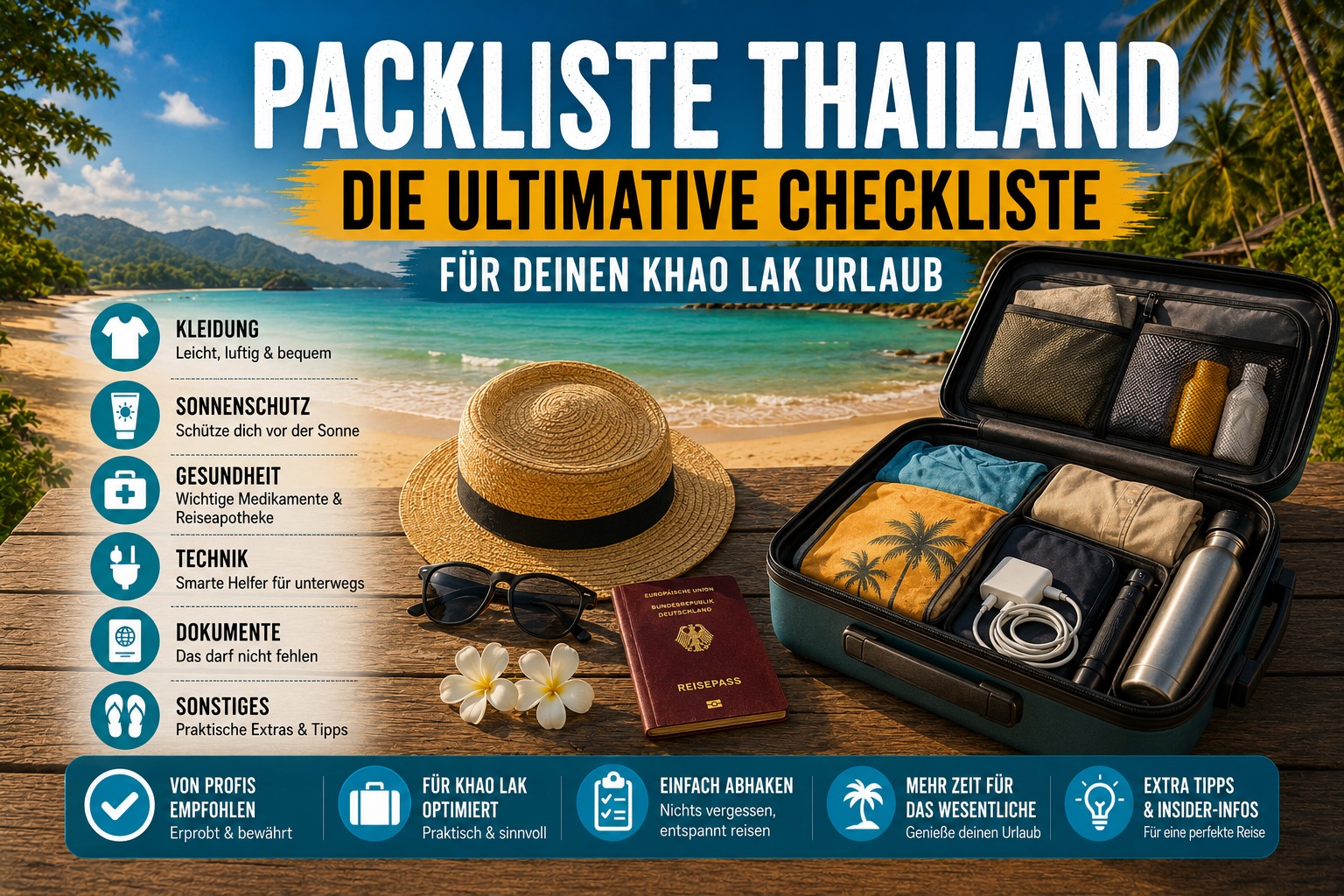
Before we go into the details, here’s the absolute essentials of your Thailand packing list, so you can get an initial overview. These are the things you really shouldn’t forget before you set off on your Khao Lak holiday:
| Category | Essential items | Notes |
|---|---|---|
| Documents | Passport (valid for at least 6 months!), flight tickets, international health insurance, credit cards, copies | In your hand luggage and digitally! |
| Clothing | Lightweight, breathable fabrics, swimwear, temple attire, lightweight rain jacket | Less is more – laundry services are cheap! |
| Health | Personal medication, mosquito repellent (containing DEET), sun cream (SPF 30–50+), small first-aid kit | Sun protection and mosquito repellent are essential in Thailand! |
| Tech | Smartphone, chargers, power bank, universal adaptor | For connectivity and power. |
| Money | Two credit cards, some cash in THB to get you started | Notify your bank in advance. |
| Hygiene | Travel-size items, special products if needed | Many items are available cheaply locally. |
| Miscellaneous | Sunglasses, sun hat, water bottle, small bag/rucksack | For everyday use and excursions. |
Travel documents: Your ticket to paradise
This section is worth its weight in gold and absolutely must be in your hand luggage! Nothing is more frustrating than realising at the airport or in your hotel that important documents are missing or out of reach. Here’s your checklist of the essentials:
- Passport: Very important – it must be valid for at least another 6 months upon entry! It’s best to make a digital copy (e.g. as a photo on your mobile and in the cloud) and a paper copy, which you should keep separate from the original. Also leave a copy with someone you trust at home.
- Flight tickets & booking confirmations: Whether printed out or on your smartphone – have all the details for flights, hotels and hire cars (if applicable) to hand. A clear digital folder structure on your mobile or tablet is worth its weight in gold here.
- Overseas health insurance: An absolute must! The cost of medical treatment can be high in Thailand. Make sure you have the emergency number and your insurance details to hand. Check in advance whether your insurance provider offers direct billing and what steps to take in an emergency. Also have a look at our article on ‘What vaccinations do you need for Thailand?’ to ensure you’re fully prepared health-wise.
- Credit cards: It’s best to take two different cards (e.g. Visa and Mastercard) with you and keep them separate. That way, you’re on the safe side if one doesn’t work or gets lost. Let your banks know about your trip in advance to avoid your cards being blocked! A debit card can be a good addition .
- Some cash: For the first few hours after arrival, a few THB (Thai baht) is really handy – for a taxi, a snack or a tip. It’s best to exchange larger amounts locally at a better rate or withdraw them from a cash machine (watch out for fees!). You can find out more in our article on ‘Money in Thailand’.
- Digital Arrival Card: The old paper arrival forms handed out on the plane are a thing of the past! Thailand has digitised the process to reduce waiting times at immigration. You’ll need to fill in this form online before your flight. Make sure you have your flight number and the address of your accommodation in Khao Lak to hand. You can fill in your digital arrival card in advance here. You can also find the latest information on entry requirements in our blog post ‘Entering Thailand’.
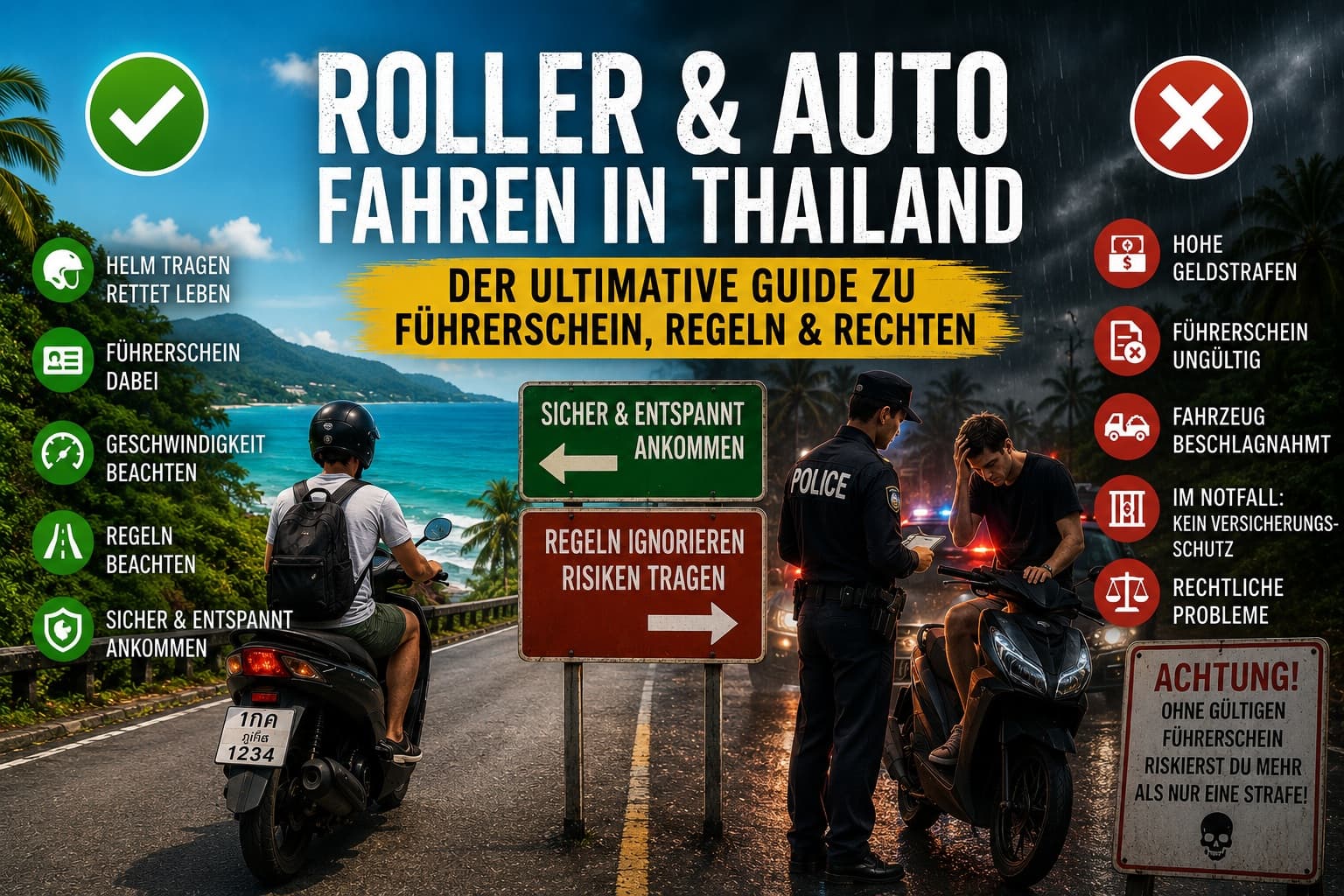
- International driving licence: Are you planning to ride a scooter or drive a hire car whilst you’re there? If so, an international driving licence, along with your national driving licence, is absolutely essential. To ride a scooter in Thailand, you (officially) need a Class A motorbike licence. Without this, you may encounter problems with insurance in the event of an accident. Be aware of the risks and ride carefully!
- Hotel documents & vouchers: Confirmations for accommodation, booked tours or transfers – you should have everything to hand digitally and, ideally, in printed form too. That way, you’ll be on the safe side should your mobile phone play up.
Important insider tip: Take photos of all important documents (passport, driving licence, credit cards, insurance emergency contacts) and store them in a password-protected cloud service or email them to yourself. That way, you’ll always have access to them in an emergency, even if everything else is lost. It’s also a good idea to leave an extra printed copy with a family member at home.
| Documents & Finances Checklist (hand luggage!) |
|---|
| ✅ Passport (valid for at least 6 months!) |
| ✅ Digital & paper copies of your passport |
| ✅ Flight tickets & booking confirmations |
| ✅ Overseas health insurance (details, emergency number) |
| ✅ 2 credit cards (keep them separate) |
| ✅ Some cash (THB) |
| ✅ International driving licence (if renting a scooter or car) |
| ✅ Hotel & tour vouchers |
| ✅ Medical certificate for any special medication (if required) |
| ✅ List of important telephone numbers (emergency contacts) |
Clothing & footwear: Light, airy and practical
Khao Lak is hot, humid and wonderfully relaxed. Your clothing should reflect this. Opt for light, breathable fabrics such as linen, thin cotton or viscose. Synthetic fibres can quickly feel clammy. Above all, clothing for Thailand must be: comfortable and quick-drying. Remember the affordable laundry services – this will significantly reduce the amount of space your clothes take up in your suitcase!
- T-shirts & tank tops: Take 5–7 with you. Preferably in light colours that reflect the sun. They form the basis of your wardrobe. Functional shirts are a good option for hikes or sporting activities, as they wick away moisture well.
- Shorts & skirts: 3–4 items are enough. Comfortable shorts, loose skirts or breezy beach trousers are ideal. Jeans are usually too warm and take a long time to dry.
- Lightweight clothing (everyday wear): Thin blouses, loose-fitting shirts, beach dresses – anything that’s lightweight and dries quickly. These are perfect for the day and a relaxed evening.
- Long-sleeved and long-legged clothing for protection against mosquitoes and the sun: A lightweight long-sleeved top and a pair of long, thin trousers (e.g. made of linen or a special travel fabric) are worth their weight in gold. They protect you from mosquito bites in the evening and from sunburn during the day when you need a break from direct sunlight. They’re also ideal for visiting temples.
- Swimwear: Feel free to pack 2–3 sets so you always have something dry to change into. Even though the sun dries things quickly, it’s more comfortable not to walk around all day in wet swimming trunks or a wet bikini. They’re, of course, essential for beautiful beaches like Coconut Beach or trips to the Similan Islands.
- Flip-flops / sandals: The ultimate choice for everyday use! They’re light, airy and quick to slip on and off. One pair is more than enough. Make sure they’re good quality, as you’ll be wearing them a lot.
- Trainers / closed shoes: A pair of comfortable trainers or lightweight canvas shoes is a good idea for the flight, longer walks or excursions where you’ll need a bit more support. They’re also ideal for keeping your feet warm in air-conditioned rooms.
- Rain jacket / Lightweight poncho: Even if you’re not travelling to Thailand during the rainy season, short, heavy showers can occur. A lightweight, packable rain jacket or a compact poncho takes up hardly any space and will protect you from an unexpected downpour.
- Sun hat / cap: Absolutely essential for protection from the intense tropical sun. A wide-brimmed hat is ideal for protecting your face and neck.
- Sunglasses: Not just stylish, but essential for protecting your eyes from UV rays.
Important insider tip: Respectful clothing for temple visits: This is an absolute must in Thailand! When visiting temples or other sacred sites, your shoulders and knees must be covered. Always pack a scarf, a sarong or a pair of lightweight long trousers/a maxi skirt, which you can slip on quickly. Show respect for the local culture – it’s greatly appreciated. Lightweight, long clothing and sturdy shoes are also advisable for visiting Khao Sok National Park.
| Clothing & Shoes | What to pack |
|---|---|
| 5–7 T-shirts or vests | ✅ |
| 3–4 pairs of shorts, skirts or beach trousers | ✅ |
| 1–2 lightweight long-sleeved tops or long trousers (for protection against mosquitoes, the sun or for visiting temples) | ✅ |
| 2–3 swimsuits | ✅ |
| Flip-flops or sandals | ✅ |
| Comfortable trainers or closed-toe shoes | ✅ |
| Lightweight rain jacket or poncho | ✅ |
| Sun hat or cap | ✅ |
| Sunglasses | ✅ |
| Sarong or light scarf (versatile) | ✅ |
Tech & Gadgets: For drone pilots and content creators
We know that many of you like to capture your travel experiences – whether with a camera, a smartphone or even a drone. Here are a few tech must-haves for your trip to Thailand:
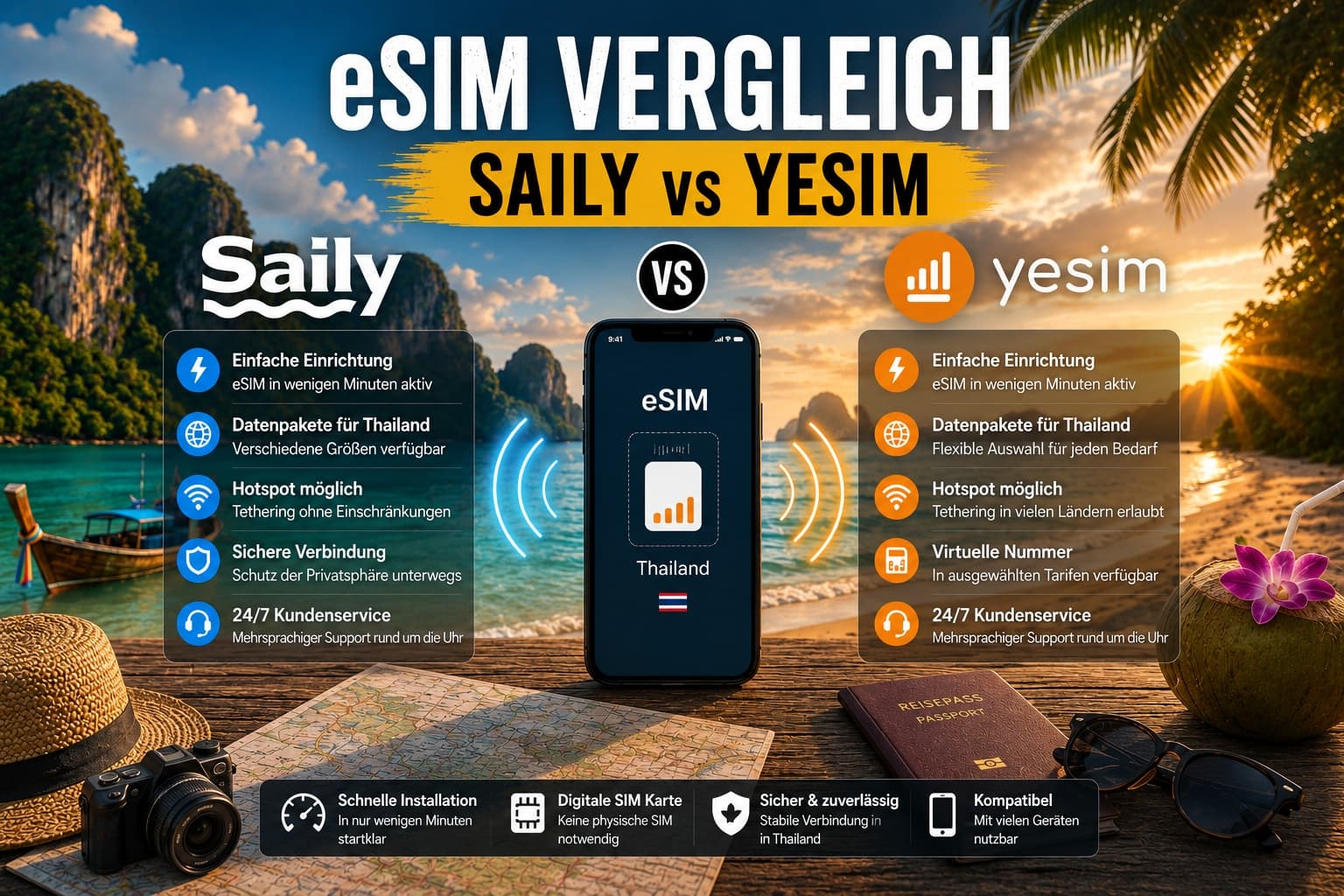
- Smartphone: Your all-rounder for navigation, communication, photos and much more. An unlocked smartphone is particularly handy for using a local SIM card and browsing the internet affordably. Local SIM cards are available at low cost at the airport or in 7-Eleven shops.
- Chargers & cables: For all your devices, of course. Before you set off, check that you’ve really got all the cables you need (USB-C, Lightning, Micro-USB, etc.).
- Power bank: A lifesaver for long days on the go! Nothing is more annoying than your mobile running out of power right at the best moment. But be careful: check your airline’s guidelines regarding the watt-hour rating in your hand luggage (usually up to 100 Wh without authorisation, up to 160 Wh with authorisation). Power banks must always be carried in your hand luggage, never in your hold luggage!
- Camera & accessories: Whether it’s an SLR, a mirrorless camera, a GoPro or an action cam – if you want to take photos and videos, don’t forget your camera. Extra batteries and memory cards are also a must, so you don’t miss out on the best moments.
- Multi-socket adapter: These can be very handy if you want to charge lots of gadgets at the same time and there are only a few sockets in your room. But do check the maximum load capacity and voltage.
- Universal adaptor: Although German plugs (Type F) often fit into sockets in Thailand (Types A, B, C, F, G), a universal adapter is the safest choice. That way, you’ll be prepared for any eventuality and won’t have to worry about sockets in Thailand. The voltage in Thailand is 220V at 50Hz, which is compatible with most European devices.
- Headphones: Whether it’sNoise-cancelling headphones for a long flight or small in-ear headphones for listening to music on the beach – headphones are a faithful companion.
- E-reader / tablet: For relaxing reading sessions on the beach or in your hotel. Perfect for passing the time whilst waiting.
Very important for drone pilots: If you’re bringing a drone to take footage, you must register it with the CAAT (Civil Aviation Authority of Thailand) and the NBTC (National Broadcasting and Telecommunications Commission) in Thailand! This must be done before your first flight and can take up to 2–3 weeks. Flying without registration can result in heavy fines or even imprisonment. Make sure you find out in good time – the regulations are taken very seriously! There are also restrictions on flying over certain areas, such as national parks (e.g. Khao Sok National Park) or temples.
| Item | Take with you |
|---|---|
| Smartphone | ✅ |
| Chargers & compatible cables | ✅ |
| Power bank (in hand luggage) | ✅ |
| Camera (optional) | ✅ |
| Spare batteries & memory cards | ✅ |
| Universal adaptor | ✅ |
| Multi-socket adaptor (optional) | ✅ |
| Headphones | ✅ |
| E-reader / tablet (optional) | ✅ |
| Drone (optional, note registration requirements) | ✅ |
First-aid kit & toiletries: Sun and mosquito protection
Your health is the most important thing! Even though there are plenty of pharmacies in Thailand and supplies are plentiful, it’s a good idea to have the basics with you. This is especially true when it comes to specific medicines or personal preferences. Your first-aid kit for Thailand should be well thought out so that you can treat minor ailmentsstraight away.
Important note: This list is for guidance only. If you have any questions or concerns, always seek medical advice and discuss your individual first-aid kit and the quantities of your personal medication required with your doctor or pharmacist. We do not provide any recommendations regarding dosage or treatment.
- Personal medication: If you take specific medication regularly, make sure you pack enough to last for the entire duration of your trip. Carry a medical certificate (preferably in English) with you if your medication is prescription-only, to avoid any problems on entry. Keep it in your hand luggage!
- Painkillers / fever reducers: Medicines for headaches, mild pain or fever (e.g. paracetamol, ibuprofen) should always be carried.
- Plasters & blister plasters: Blisters can quickly become an issue, particularly with new shoes or on longer hikes. A small first-aid kit containing various plasters, including waterproof ones, is always a good idea.
- Hand sanitiser: A small bottle of hand sanitiser for when you’re out and about, and disinfectant wipes for minor cuts and grazes. Hygiene is particularly important in tropical climates.
- Medication for diarrhoea: On holiday, your stomach can sometimes play up. Medicines for acute diarrhoea (e.g. loperamide) and electrolytes to replenish lost fluids and salts can be a real lifesaver. Also, make sure you practise good food and drink hygiene.
- Clinical thermometer: A small, digital clinical thermometer helps to detect a fever quickly and reliably.
- Mosquito repellent: Strong mosquito repellent containing DEET (diethyltoluamide) or icaridin is most effective against tropical mosquitoes. However, you can also easily buy it locally – local products such as ‘Soffell’ from 7-Eleven or local chemists are inexpensive and work a treat. Mosquito protection is essential in Thailand, particularly in the evenings, to avoid dengue fever or other mosquito-borne diseases. A mosquito net may also be worth considering for light sleepers if your accommodation doesn’t provide one.
- Sun protection: High-quality sun cream with a high sun protection factor (SPF 30–50+)! In Thailand, good sun cream is often significantly more expensive than at home and the range of suitable products can be limited. So it’s best to bring some from home and reapply generously, especially after swimming. Make sure to use waterproof products.
- After-sun lotion / aloe vera: Just in case the sun gets a bit too much. A cooling and moisturising lotion soothes the skin.
- Allergy medication: If you’re prone to allergies (hay fever, insect bites), pack your usual medication.
- Eye drops: For dry eyes (air conditioning, flying) or irritation caused by salt water or chlorine.
- Travel sickness tablets: If you suffer from travel sickness, particularly on boat trips or winding roads.
Important insider tip: Even though you can buy plenty of things locally, when it comes to medication in particular, it’s better to stick to tried-and-tested products from home that you know you can tolerate. The Thai healthcare system is good, but in an emergency it’s reassuring to have your own little first-aid kit with you.
| First-aid kit & toiletries | Packing |
|---|---|
| Personal medication, with a doctor’s note if necessary | ✅ |
| Painkillers / fever reducers | ✅ |
| Plasters & blister plasters | ✅ |
| Hand and wound disinfectant | ✅ |
| Medicines for diarrhoea | ✅ |
| Electrolytes | ✅ |
| Clinical thermometer | ✅ |
| Highly effective mosquito repellent | ✅ |
| Sun cream with SPF 30–50+ | ✅ |
| After-sun lotion or aloe vera | ✅ |
| Allergy medication, if required | ✅ |
| Eye drops, if required | ✅ |
| Travel sickness tablets, if needed | ✅ |
| Small scissors and tweezers | ✅ |
| Lip balm with SPF | ✅ |
| Travel-size toiletries | ✅ |
For the flight: comfort on long-haul journeys
The flight to Thailand is a long one. This makes it all the more important to make your time on the plane as comfortable as possible. Your hand luggage for Thailand should be optimally prepared for this.
- Neck pillow: An inflatable or soft neck pillow can make all the difference between a stiff neck and a restful nap.
- Headphones: Whether for the in-flight entertainment or your own music/podcasts – good headphones are worth their weight in gold. Noise-cancelling headphones block out the noise of the flight and make for a more peaceful journey.
- Snacks: Even though in-flight meals are provided, it’s always a good idea to bring a few snacks of your own (muesli bars, nuts, fruit) to satisfy those little hunger pangs between meals and avoid having to rely on overpriced alternatives. Check the import regulations for food.
- Ballpoint pen: Always handy! For filling in forms (in case paper is still required) or simply for taking notes. Keep it to hand – you never know when you might need it.
- Compression stockings (if required): They can help prevent swelling in your legs, particularly on long flights, and minimise the risk of thrombosis. It’s best to speak to your doctor about this.
- Entertainment: A good book, an e-reader,-reader, pre-downloaded films or TV series on your tablet or smartphone – make sure you’ve got plenty of entertainment so the hours fly by.
- Moisture wipes / refreshing spray: The air on the plane is dry. A small moisture wipe or a facial spray can work wonders and help you feel refreshed.
- Warm socks / light jumper: Even if you’re flying to a warm country, it can get quite chilly on the plane. An extra layer will make the flight more comfortable.
| For the flight (hand luggage) | Take with you |
|---|---|
| Neck pillow | ✅ |
| Headphones (noise-cancelling recommended) | ✅ |
| Snacks (no liquids) | ✅ |
| Pen | ✅ |
| Compression socks (if needed) | ✅ |
| Entertainment (book, e-reader or films) | ✅ |
| Wet wipes or refreshing spray | ✅ |
| Warm socks or a light jumper | ✅ |
| Sleep mask or earplugs | ✅ |
For the beach: enjoy the sun, sand and sea
Khao Lak is famous for its kilometres of sandy beaches and turquoise-blue sea. To ensure you can enjoy your days on the beach or on a boat trip to the full, pack these items:
- Dry bag (waterproof bag): An absolute must-have for boat trips to the Similan Islands or Khao Sok National Park. It reliably protects your valuables, mobile phone and camera from water, sand and moisture.
- Water shoes: If you have sensitive feet or are planning to go snorkelling or kayaking in rockier areas, water shoes offer good protection against sharp stones or sea urchins.
- Snorkelling kit (mask, snorkel): If you enjoy snorkelling and don’t want to rely on the hire kits available locally, it’s worth getting your own kit. The quality is often better, and you’ll know who last used it. This is brilliant for exploring the underwater world around Khao Lak, especially on trips to the offshore islands.
- Beach towel / sarong: A lightweight microfibre beach towel dries quickly and takes up very little space. A sarong is even more versatile – it can be used as a beach towel, scarf, skirt or shoulder cover.
- Water bottle (reusable): Keeps your drinks cool and helps reduce plastic waste. Many accommodation providers offer water dispensers for refilling. Staying well-hydrated is extremely important, especially in the heat.
- Sun cream & after-sun lotion: Yes, I’m deliberately repeating myself here! The sun’s rays are particularly intense on the beach or on a boat. Remember to reapply sun cream regularly and to moisturise your skin with after-sun lotion after sunbathing.
- Small beach bag: For everything you take to the beach. A lightweight bag that can get wet is ideal.
| For the beach | What to take |
|---|---|
| Dry bag (waterproof bag) | ✅ |
| Water shoes (optional) | ✅ |
| Snorkelling kit (optional, your own kit) | ✅ |
| Beach towel or sarong | ✅ |
| Reusable water bottle | ✅ |
| Sun cream (SPF 30–50+) | ✅ |
| After-sun lotion or aloe vera | ✅ |
| Small beach bag | ✅ |
For children: A family holiday in Khao Lak
A family holiday in Khao Lak is a dream come true! To ensure even the little ones are well prepared and parents can relax and enjoy themselves, here’s a special packing list for Thailand with children.
- Child-friendly first-aid kit: As well as general medicines for adults, be sure to bring child-friendly painkillers and fever reducers, medication for febrile convulsions (if necessary), age-appropriate diarrhoea medication (e.g. electrolytes for children), wound ointment, child-friendly plasters and special insect repellent for children. Be sure to check with your paediatrician.
- Sun protection for children: High SPF (50+) and waterproof sun cream specifically for children is a must! Also, UV-protective clothing (T-shirts, swimwear), a sun hat with neck protection and a well-fitting pair of children’s sunglasses. Children’s skin is extremely sensitive.
- Swimwear & water toys: Several sets of swimwear, swim nappies for babies and toddlers, water wings/swim vests (even if the hotel provides them – your own equipment is often a better fit). Small, lightweight water toys such as a little spade and moulds for the sandy beach are great fun.
- Lightweight clothing for children: Similar to that for adults: lightweight, breathable fabrics. Shorts, T-shirts, light dresses. Here too, quick-drying materials are ideal. A pair of light trousers and a long-sleeved top provide protection from mosquitoes in the evening.
- Light jacket / jumper: For air-conditioned rooms or cool evenings, in case the weather takes a turn.
- Comfortable shoes: Sandals, flip-flops and a pair of closed, comfortable shoes (trainers) for outings.
- Favourite toy / cuddly toy: A little piece of home can provide comfort and help ward off boredom. A colouring book or some small travel games are also good for the flight or whilst waiting.
- Snacks and special baby food: Although plenty is available in Thailand, familiar snacks or special baby food (jars, powdered milk) for the first few days can be worth their weight in gold in helping with the adjustment. For older children, muesli bars or dried fruit are good sources of energy.
- Wet wipes & hand sanitiser: For quick cleaning on the go. Hygiene is especially important when travelling with young children.
- Baby carrier / pushchair: Depending on the child’s age and planned activities. A lightweight, foldable pushchair is handy for walks, whilst a baby carrier is better for jungle treks or on uneven terrain. Many roads and paths in Khao Lak aren’t pushchair-friendly, so a baby carrier is often more versatile.
- Travel cot (optional): Many hotels provide cots, but bringing your own lightweight travel cot can be more reassuring for babies who are very used to their own bed.
Important insider tip: Bear in mind that children in Thailand often receive a lot of attention and are treated very kindly. Don’t hesitate to ask for help or make special requests. Many restaurants also offer child-friendly meals.
| For children | What to bring |
|---|---|
| Child-friendly first-aid kit | ✅ |
| Sun protection (SPF 50+, UV-protective clothing, sun hat and sunglasses) | ✅ |
| Several swimsuits & swim nappies | ✅ |
| Armbandsor life jacket (if needed) | ✅ |
| Lightweight water toys | ✅ |
| Lightweight clothing (short-sleeved and long-sleeved) | ✅ |
| Light jacket or jumper | ✅ |
| Sandals and trainers | ✅ |
| Favourite toys or entertainment | ✅ |
| Snacks & baby food (for the first few days) | ✅ |
| Wet wipes & hand sanitiser | ✅ |
| Baby carrier or lightweight pushchair (optional) | ✅ |
| Travel cot (optional) | ✅ |
For the rainy season: Well prepared for tropical showers
The rainy season in Thailand (from around May to October) in Khao Lak doesn’t mean constant rain, but often short, heavy showers which refresh the air. With the right kit, you can enjoy this time of year just as much. Whilst the best time to visit Khao Lak is often the dry season, the rainy season has its own charm – often fewer tourists and more lush vegetation!
- Lightweight rain jacket / poncho: A must-have! Compact and easy to pack away, it protects you from sudden rain showers. A breathable fabric is more comfortable.
- Waterproof shoes / sandals: Ordinary trainers take ages to dry and can become uncomfortable. Waterproof sandals or lightweight, quick-drying walking shoes are ideal. Closed shoes are also helpful against blood-sucking insects in the jungle.
- Dry bag: Once again: essential! Your electronics, documents and dry clothes are safe here, even in a downpour.
- Umbrella: A small, foldable umbrella is often more practical than a rain jacket for short trips around town or to a restaurant.
- Quick-drying clothing: When choosing your clothes, pay particular attention to quick-drying fabrics such as technical fibres or special blended fabrics. Cotton dries very slowly in high humidity.
- Mosquito repellent (extra strong): There tend to be more mosquitoes during the rainy season. Your mosquito repellent for Thailand should therefore be particularly effective. Also remember to bring something to soothe bites.
- Anti-mould spray (optional): For delicate kit or clothing that takes a long time to dry. However, this isn’t strictly necessary if you air things out properly.
Important insider-tip: Rain showers often pass just as quickly as they arrive, and afterwards the sun comes out again. Make the most of the rainy season to experience the lush green countryside and enjoy the often lower number of tourists. Many tours still take place during the rainy season; just make sure you have good rainwear and waterproof pack sacks for your valuables.
| For the rainy season | What to bring |
|---|---|
| Lightweight rain jacket or poncho | ✅ |
| Waterproof shoes or quick-drying sandals | ✅ |
| Dry bag (waterproof pouch) | ✅ |
| Small umbrella | ✅ |
| Quick-drying clothing | ✅ |
| Mosquito repellent (extra strong) | ✅ |
| Anti-mould spray (optional) | ✅ |
Things you DON’T need to take
As mentioned before: less is more! Many items you might instinctively pack are either superfluous, unnecessarily expensive or easily available locally in Thailand. This saves space in your suitcase and reduces the weight on the scales. A streamlined packing list for Thailand is a stress-free packing list.
- Warm clothing / winter jackets: Even for air-conditioned rooms, a thin cardigan or a light jacket is sufficient. Outdoor temperatures are consistently high.
- Lots of sturdy shoes: One pair of trainers or light, closed-toe shoes is perfectly adequate. High heels or heavy boots are impractical and unnecessary.
- Expensive jewellery / valuables: It’s best to leave valuables at home. This minimises the risk of loss or theft and means you don’t have to worry.
- Loads of toiletries: Toothpaste, shower gel, shampoo, body lotion – you can buy all of these cheaply in Thailand at any supermarket (e.g. 7-Eleven, Big C, Tesco Lotus) at affordable prices. Often even in handy travel sizes. You should only bring your favourite products with you if they’re specific branded items or if you have very sensitive skin.
- Hairdryer: Many hotels provide a hairdryer. If not, your hair will usually dry very quickly on its own in the tropical air.
- Printed travel guides: It’s best to rely on digital travel guides on your smartphone or tablet. This saves weight and ensures you always have the latest information to hand. You can also find local insider tips right here on our blog!
- Towels: Towels are provided as standard in hotels. For the beach, a microfibre beach towel is sufficient and dries quickly.
- Pyjamas: Most people in Thailand sleep in light shorts and T-shirts, or not at all, as it’s often still very warm at night. Lightweight cotton or linen are best here.
- Oversized books: If you don’t want to use an e-reader, opt for paperbacks. Alternatively, there are often book-swapping schemes in hostels or hotels.
| Things you don’t need to take | Not required |
|---|---|
| Thick clothing or winter jackets | 🚫 |
| Lots of sturdy shoes (e.g. high heels or heavy boots) | 🚫 |
| Expensive jewellery or unnecessary valuables | 🚫 |
| Large quantities of standard toiletries | 🚫 |
| Hairdryers (except for a small travel hairdryer if needed) | 🚫 |
| Paper travel guides | 🚫 |
| Towels (except for a lightweight microfibre beach towel) | 🚫 |
| Thick pyjamas | 🚫 |
| Large, heavy books | 🚫 |
Common packing mistakes: What travellers often get wrong
You learn from experience – and I’m happy to share my experiences with you so that you can avoid these common mistakes on your Thailand packing list and enjoy your Khao Lak holiday right from the start.
- Packing too many clothes: The classic mistake! People tend to plan a new outfit for every day. But thanks to laundry services and the quick-drying climate, this is completely unnecessary. Cut down on your luggage and you won’t regret it.
- Unsuitable fabrics: Cotton jeans, thick jumpers or fabrics that take ages to dry and feel clammy are unsuitable for Thailand’s tropical climate. Opt for linen, viscose, thin cotton or breathable technical fabrics.
- Forgetting or underestimating sun protection: The Thai sun is intense. A sunburn is not only painful but also increases the risk of skin damage. Always use a high SPF, reapply regularly and avoid the midday sun.
- Neglecting mosquito repellent: Mosquitoes are not only a nuisance but can also transmit diseases. Never underestimate the need for mosquito repellent in Thailand, particularly in the evening or when out in the countryside.
- Not carrying copies of your documents: In the event of loss ortheft, copies of your passport, flight tickets and insurance documents are invaluable. Keep them separate from the originals and also save digital copies.
- Failure to inform your bank: Is your bank blocking your credit card because it suspects unusual transactions from Thailand? Always inform them in advance of your travel dates and destinations to avoid unnecessary hassle. The same applies to ‘money in Thailand’ and withdrawing cash from ATMs.
- Forgetting essential medication: If you rely on specific medication, make sure you pack enough of it and keep it in your hand luggage. Obtaining it locally can be difficult or time-consuming.
- Not having a universal adaptor: Even though many sockets are compatible, a universal adaptor gives you the peace of mind that you can charge all your devices. Nothing is more annoying than a flat mobile phone whilst on holiday.
- Not preparing for temple visits: You’ll be refused entry to temples if your shoulders and knees are uncovered. A sarong or a large scarf in your rucksack solves this problem quickly and respectfully.
- Ignoring drone registration: An absolute no-go for drone pilots! The penalties are severe. Find out the requirements and register your drone BEFORE you fly.
| Common packing mistake | How to avoid it |
|---|---|
| Packing too many clothes – less is usually more. | ❌ |
| Choosing unsuitable fabrics that take a long time to dry or make you sweat heavily. | ❌ |
| Underestimating sun protection – always pack plenty of sun cream (SPF 30–50+). | ❌ |
| Neglecting mosquito repellent – particularly important in the evening. | ❌ |
| Not taking copies of important documents with you. | ❌ |
| Failing to inform your bank about your stay abroad before travelling (advisable depending on the bank). | ❌ |
| Forgetting important personal medication. | ❌ |
| Not packing a universal adaptor. | ❌ |
| Not bringing suitable clothing for visiting temples (shoulders and knees must be covered). | ❌ |
| Not checking the necessary regulations for drones in advance. | ❌ |
Conclusion: Your Khao Lak checklist – all set for your dream holiday!
There you have it, your ultimate packing list for a relaxing and unforgettable holiday in Khao Lak! I hope this guide takes away any anxiety about forgetting something important and helps you pack smartly and lightly. Remember: Thailand is a modern country and in Khao Lak you’ll find almost everything you might need at a moment’s notice in local supermarkets (such as 7-Eleven) and chemists – from sun cream and mosquito repellent to toothpaste. Focus on the essentials, protect yourself from the sun and mosquitoes, keep your documents safe, and be open to all the wonderful experiences Thailand has in store for you.
Pack smart, pack light and, above all: enjoy every single moment in our tropical paradise! I look forward to seeing you in Khao Lak!
---
Packing checklist to tick off: your final check
Use this comprehensive list to make sure you’ve really packed everything you need for your holiday in Khao Lak, Thailand. Happy packing and have a great trip!
# 1. Travel documents & finances
- [ ] Passport (valid for at least 6 months beyond your travel dates)
- [ ] Copies of your passport (physical and digital, kept separate from the original)
- [ ] Flight tickets & booking confirmations (digital & printed)
- [ ] Overseas health insurance (documents, emergency numbers)
- [ ] Credit cards (at least 2, kept separately, banks informed)
- [ ] Debit card (optional)
- [ ] Some cash in THB for when you arrive
- [ ] International driving licence & national driving licence (if hiring a scooter or car)
- [ ] Hotel & tour vouchers
- [ ] Medical certificate for specific medication (in English)
- [ ] Digital arrival card (completed online in advance)
- [ ] List of important telephone numbers (emergencies, banks)
# 2. Clothing & Footwear
- [ ] 5–7 T-shirts / tank tops
- [ ] 3–4 pairs of shorts / skirts / beach trousers
- [ ] 1–2 light long-sleeved tops (protection from the sun/mosquitoes, temple visits)
- [ ] 1–2 pairs of light, long trousers (protection from the sun/mosquitoes, temple visits)
- [ ] 2–3 swimsuits
- [ ] 1 pair of flip-flops / comfortable sandals
- [ ] 1 pair of comfortable trainers / closed-toe shoes
- [ ] Lightweight rain jacket / poncho
- [ ] Sun hat / cap
- [ ] Sunglasses
- [ ] Sarong / large scarf (versatile, for temples)
- [ ] Sufficient underwear & socks
# 3. Tech & Gadgets
- [ ] Smartphone
- [ ] Chargers & compatible cables
- [ ] Power bank (in hand luggage!)
- [ ] Camera & accessories (spare batteries, memory cards)
- [ ] Universal adaptor
- [ ] Multi-socket adaptor (optional)
- [ ] Headphones
- [ ] E-reader / tablet (optional)
- [ ] Drone (if registered!)
# 4. First-aid kit & hygiene
- [ ] Personal medication (sufficient quantity, medical certificate)
- [ ] Painkillers / fever reducers
- [ ] Plasters & blister plasters
- [ ] Disinfectant (for hands, wounds)
- [ ] Medicines for diarrhoea & electrolytes
- [ ] Clinical thermometer
- [ ] Insect repellent (highly effective, local ingredients if applicable)
- [ ] Sun cream (SPF 30–50+, waterproof)
- [ ] After-sun lotion / aloe vera
- [ ] Allergy medication (if required)
- [ ] Eye drops (if required)
- [ ] Travel sickness tablets (if required)
- [ ] Small scissors & tweezers
- [ ] Lip balm with SPF
- [ ] Toothbrush & toothpaste (travel-size to start with)
- [ ] Small travel-size containers for shampoo, shower gel and soap (to start with)
# 5. For the flight
- [ ] Neck pillow
- [ ] Headphones
- [ ] Snacks
- [ ] Pen
- [ ] Compression socks (if needed)
- [ ] Entertainment (book, e-reader, films)
- [ ] Wet wipe / refreshing spray
- [ ] Warm socks / light jumper
- [ ] Sleep mask / earplugs
# 6. For the beach
- [ ] Dry bag (waterproof bag)
- [ ] Water shoes (optional)
- [ ] Snorkelling kit (optional)
- [ ] Beach towel / sarong
- [ ] Water bottle (reusable)
- [ ] Small beach bag
# 7. For children (additional)
- [ ] Child-friendly first-aid kit
- [ ] Sun protection for children (SPF 50+, UV-protective clothing, hat, sunglasses)
- [ ] Several swimsuits & swim nappies
- [ ] Water wings / life jacket
- [ ] Lightweight water toys
- [ ] Favourite toys / entertainment
- [ ] Snacks & baby food (to get you started)
- [ ] Wet wipes & hand sanitiser
- [ ] Baby carrier / lightweight pushchair (optional)
---
FAQ: Frequently asked questions about the Thailand packing list
Q: Do I need an adapter for power sockets in Thailand? A: Thailand uses plug types A, B, C, F and G. German plugs (type F) often fit, but a universal adapter gives you the best guarantee that you’ll be able to charge all your devices without any problems. The voltage is 220V/50Hz.
Q: Can I buy sun cream and mosquito repellent in Thailand? A: Yes, both are available in Thailand in supermarkets (e.g. 7-Eleven) and chemists. Local products such as ‘Soffell’ mosquito repellent are inexpensive and very effective. Sun cream, however, is often more expensive there than at home, so it’s advisable to bring the amount you’ll need with you.
Q: What is appropriate clothing for visiting temples? A: When visiting temples, your knees and shoulders must be covered. Pack a light long-sleeved top and a pair of long trousers or a maxi skirt. A sarong or large scarf is also a practical solution that you can quickly throw on.
Q: How much cash should I take with me to Thailand? A: It’s a good idea to have a small amount of Thai baht to hand for the first few hours after arrival (approx. 1,000–2,000 THB). You can withdraw larger amounts from cash machines (check for fees!) or exchange money at bureaux de change. Credit cards are widely accepted in larger shops and hotels.
Q: Are there laundry services in Khao Lak? A: Yes, there are numerous affordable and reliable laundry services in Khao Lak. For a small fee, you’ll get your clothes back quickly and freshly washed. So don’t pack too many outfits.
Q: Do I need to register my drone in Thailand? A: Yes, absolutely! If you’re bringing a drone to Thailand, you must register it with the CAAT and NBTC before flying. The process can take 2–3 weeks. Flying without registration results in heavy fines.
Q: Is a first-aid kit really necessary when there are local pharmacies? A: A well-stocked small first-aid kit is highly recommended. It’s reassuring to have tried-and-tested medicines to hand for minor ailments, diarrhoea or pain. It’s essential if you require specific personal medication.
Q: What is the best clothing for the rainy season in Thailand? A: Opt for quick-drying, lightweight clothing. A compact rain jacket or poncho and waterproof sandals are ideal. Also remember to bring extra-strong mosquito repellent, as mosquitoes can be more active during the rainy season.
Q: Should I inform my bank about my trip? A: Yes, definitely! Inform your bankin advance of your travel dates and destinations to prevent your credit or debit card from being blocked due to unusual transactions.
Q: Do I need an international driving licence to ride a scooter in Thailand? A: Yes, to hire and ride a scooter, you are officially required to have an international driving licence in conjunction with your national driving licence. For motorbikes, a Class A motorbike licence is also required. Without these documents, you may face significant insurance issues in the event of an accident.