Hi there, Thailand fans! Your Khao Lak Insider is back to provide you with the very latest and most accurate information on entering Thailand in 2026. Don’t worry about bureaucratic hurdles—I’ll walk you through it step by step and explain everything you need to know so your trip to the Land of Smiles gets off to a relaxed and worry-free start. As your on-the-ground visa expert, I’ve thoroughly researched all the regulations and summarized them for you. Let’s dive right in!
Entering Thailand: Visa-Free vs. Visa Required
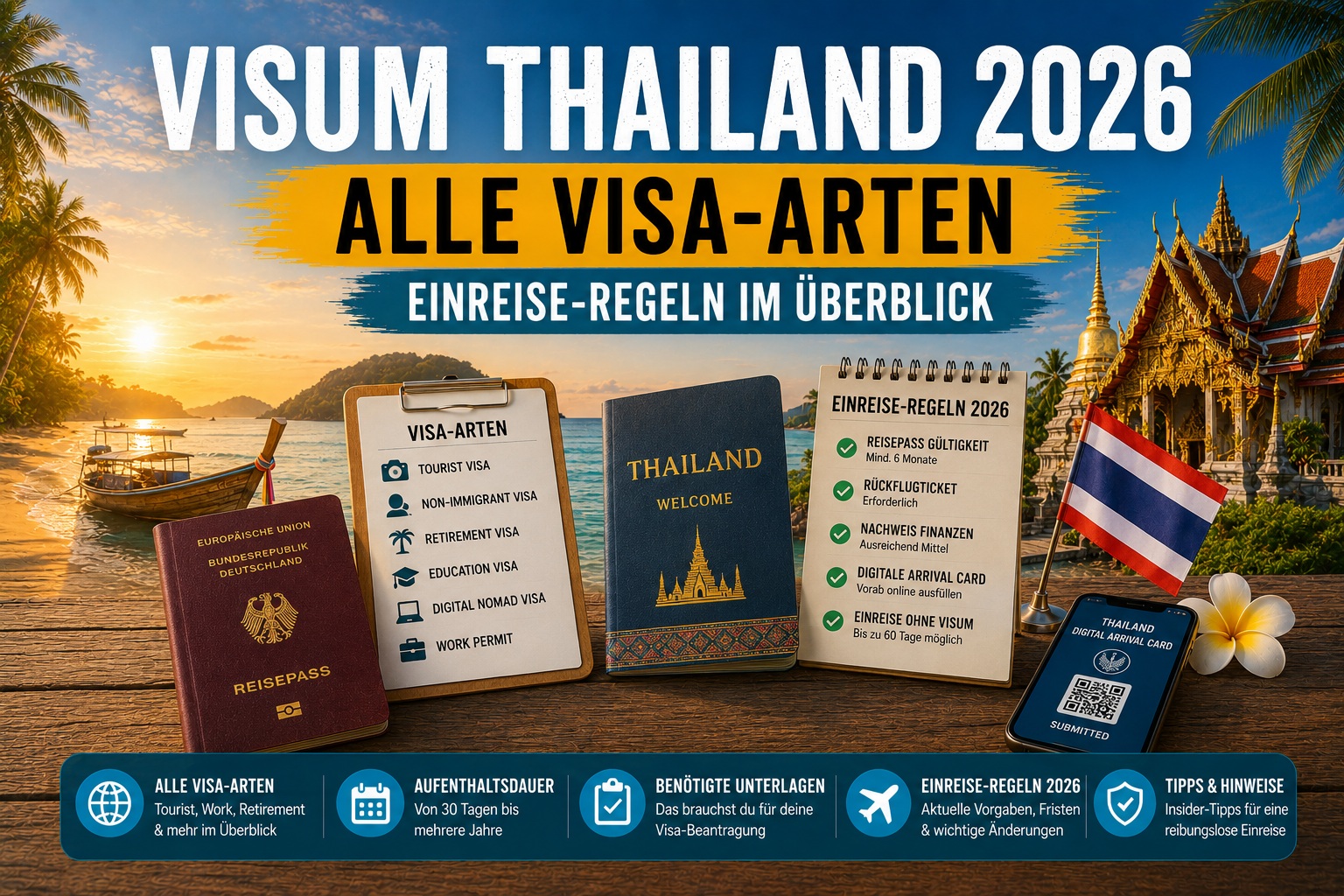
The good news for German, Austrian, and Swiss citizens is that tourist entry is often visa-free! This policy is called “Visa Exemption” and allows you to spend a certain amount of time in the country for tourist purposes without having to apply for a visa in advance.
Visa-free entry for citizens of Germany, Austria, and Switzerland currently allows you to stay for exactly 60 days. Please note, however, an important change: The Thai government has decided to reduce this limit back to 30 days. This new regulation takes effect 15 days after its official publication in the Royal Gazette. Until that date, the usual 60-day stay period still applies for entry—after that, you should plan your trip based on a 30-day stay again.
If you suddenly realize that 30 days just isn’t enough—which happens to everyone here pretty quickly—you can extend your stay (whether the initial period was 30 or 60 days) once for an additional 30 days at the local Immigration Office. There’s a fee of 1,900 THB for this. It’s best to set aside a few hours for this and take care of it well in advance of the original deadline.
The Tourist Visa (TR) for Long-Term Travelers
If you know from the start that you want to stay longer than the visa-free period, the standard Tourist Visa (TR) is your best option. It gives you planning certainty and a longer stay without the stress of having to extend your visa on-site.
The so-called “Single Entry Tourist Visa” (SETV) is valid for 90 days after issuance and allows you to stay in Thailand for 60 consecutive days after entry. As with visa-free entry, this stay can also be extended once at the local Immigration Office for an additional 30 days for a fee of 1,900 THB. In total, you could thus stay in the country for up to 90 days.
Requirements for an SETV:
- Proof of sufficient financial means: Generally, this is at least 20,000 THB per person or 40,000 THB per family (proof provided via bank statements). Note: The amount may vary, so always check the current requirements on the e-visa portal.
- A confirmed return ticket or onward ticket proving your departure within the approved period of stay.
- A valid passport with at least 6 months remaining validity.
- Proof of accommodation for the first part of your stay.
The New LTR (Long-Term Resident) Visa & DTV (Destination Thailand Visa)
Thailand has revolutionized its visa regulations to attract digital nomads, remote workers, and frequent travelers. Here are the exciting new options for 2026:
Destination Thailand Visa (DTV) The DTV is an excellent option for anyone who wants to work flexibly, study, or stay in Thailand for an extended period. It is specifically designed for freelancers, digital nomads, and participants in Thai courses.
- Who is eligible? Freelancers, digital nomads (remote workers), as well as individuals participating in Thai Muay Thai courses, cooking classes, diving courses, cultural programs, or traveling to Thailand for medical reasons (medical tourism). The minimum age is 20, and proof of funds of at least 500,000 THB in a bank account is required.
- Benefits: The DTV is valid for 5 years and allows you to stay in Thailand for up to 180 days per entry. And best of all: This stay can be extended once for an additional 180 days! That means you could spend up to 360 days a year in the Land of Smiles—perfect for immersing yourself deeply in Thai culture or running your remote business from here.
Long-Term Resident (LTR) Visa The LTR visa is aimed at specific groups of affluent or highly qualified individuals who wish to choose Thailand as their long-term second home or place of work. It offers significant advantages but comes with stricter requirements.
- Target Groups: Affluent global citizens (minimum net worth of 1 million USD, minimum annual income of 80,000 USD), affluent retirees (at least 50 years old, at least $80,000 annual income), highly qualified professionals (at least $80,000 annual income in target industries), and their family members.
- Benefits: 10-year validity, multiple entries, fast immigration processing, work permit (for skilled professionals), and various tax benefits.
Visas for Retirees (Non-Immigrant O / OA)
For many older people, Khao Lak is a popular winter retreat or even a new home. Therefore, retirement visas are particularly important here. There are two main types:
Non-Immigrant O (Retirement) This visa is intended for retirees who wish to live in Thailand for an extended period (but less than one year at a time). It is issued for 90 days and can be extended for an additional 90 days at the local Immigration Office, allowing for a maximum stay of 180 days.
- Requirements:
- Minimum age of 50.
- Proof of financial means: Either a balance of at least 800,000 THB in a Thai bank account that has been held for at least 3 months prior to the application, OR a monthly income/pension of at least 65,000 THB, verifiable through a pension certificate or bank statements.
Non-Immigrant OA (Long-Stay Retirement) The Non-Immigrant OA visa is the standard long-term retirement visa and allows for a stay of one full year. It is renewable annually as long as the requirements continue to be met.
- Requirements:
- Minimum age of 50.
- Proof of financial means: Either a balance of at least 800,000 THB in a Thai bank account that has been held for at least 12 months prior to the application, OR a monthly income/pension of at least 65,000 THB, verifiable through a pension certificate or bank statements.
- Proof of adequate Thai health insurance. This must include coverage of at least 40,000 THB for outpatient treatment and 400,000 THB for inpatient treatment in Thailand. Alternatively, international health insurance that meets these coverage requirements and provides a confirmation of coverage in English is also accepted.
The Official Application Process: The Thai E-Visa Portal
The days of complicated paper visas are over! For some time now, Thailand visa applications have been processed exclusively online and have become significantly easier.
The only official route is through the Thai E-Visa Portal: thaievisa.go.th. Please be extremely careful here! Unfortunately, there are many unscrupulous third-party websites that pose as official agencies and charge excessive fees or, in the worst case, cause problems. ALWAYS use only the official government website.
Here’s how to apply (step by step): 1. Registration: Create an account on thaievisa.go.th. 2. Select visa type: Choose the visa that’s right for you from the list (e.g., Tourist Visa, Non-Immigrant O/OA, DTV). 3. Fill out the form: Enter all required personal information truthfully. 4. Upload documents: You must upload various documents digitally. These typically include:
- A digital copy of your passport (valid for at least 6 months).
- A recent passport photo (biometric).
- A confirmed flight itinerary (round-trip).
- Proof of your accommodations (e.g., hotel reservation for the first few nights).
- Proof of financial means (e.g., a recent bank statement showing sufficient funds, pension statement).
- Depending on the type of visa, additional documents such as Thai health insurance, employment certificates, or marriage certificates may be required.
5. Pay the fees: Visa fees are paid online by credit card. 6. Wait for processing: After a successful application, you’ll receive confirmation via email.
Important Note on Processing Time: Generally, apply for your visa 2–4 weeks before your planned departure. However, during peak periods or for more complex visa types, it may take longer. So it’s best to build in some extra time to ensure everything goes smoothly.
Important upon arrival: Passport Validity & Digital Arrival Card
Even if you have a valid visa, there are two things that are absolutely crucial when entering Thailand:
Passport Validity: Your passport must be valid for AT LEAST 6 months upon entry into Thailand! This is a strict rule, and failure to comply may result in you being denied entry. Be sure to double-check the date!
Digital Arrival Card: For even faster and smoother processing at immigration in Phuket, Bangkok, or other international airports, we strongly recommend filling out the digital Arrival Card online before your departure. This replaces the former physical TM6 arrival card and helps you avoid long lines. Have your flight and passport information ready so you can fill out the form quickly. It’s best to check with your airline or the U.S. Department of State’s website shortly before your trip to find out about the current regulations for 2026, as these digital processes are constantly evolving.