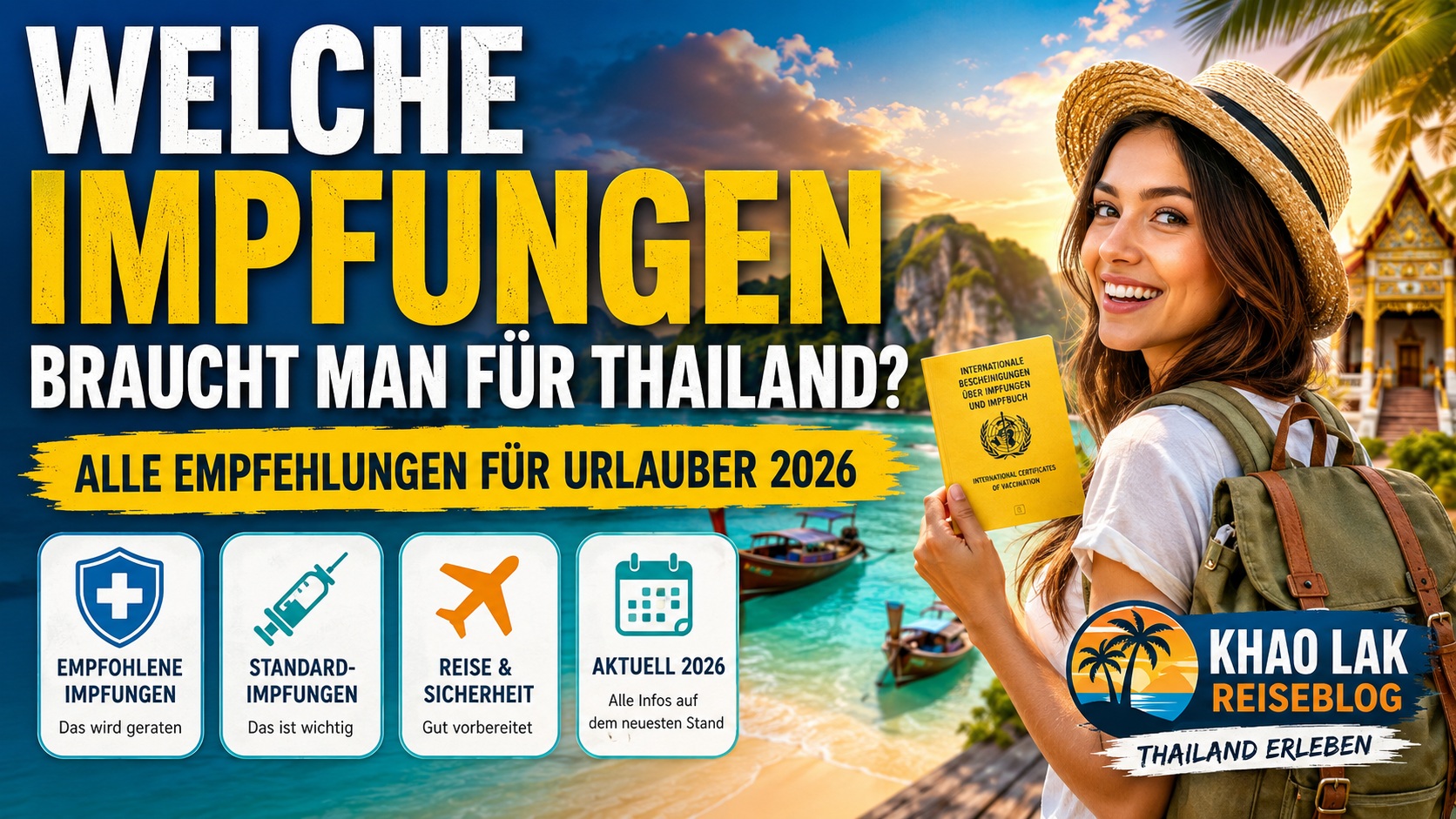
Welcome to ‘Khao Lak Insider’, your trusted friend and guide when it comes to planning the perfect trip to Thailand! As your local expert who knows the country like the back of my hand, I know that health is the top priority on holiday. One of the most common and important questions we receive is: “What vaccinations do I need for Thailand?”
Although the sun and beaches of Khao Lak are the stuff of dreams, it’s important to do your research thoroughly in advance. This article provides you with a comprehensive overview of the current vaccination recommendations for Thailand – specifically for your trip in 2026. We rely exclusively on official and medically recognised sources so that you can feel safe and well-informed. Remember: the following information is intended as a reliable guide, but is by no means a substitute for individual medical advice.
Basic information on vaccination planning: mandatory, standard and recommended
Before we go into detail, it is important to clearly distinguish between a few terms that often cause confusion:
- Compulsory vaccinations: These are vaccinations required by law in order to be allowed to enter a country. Entry will be refused without the relevant proof. There is an important exception for Thailand, which we will discuss shortly.
- Standard vaccinations: These are the vaccinations recommended in Germany by the Robert Koch Institute (RKI) and the Standing Committee on Vaccination (STIKO), which every citizen should have for general health protection – regardless of their travel destinations. These include, amongst others, tetanus, diphtheria, polio and measles.
- Travel vaccinations: These vaccinations are specifically designed to protect against diseases that occur in certain travel destinations but are not found, or are only rarely found, in Germany. They are recommended if a specific destination or the nature of the trip poses an increased risk.
- Individual recommendations: These are provided by a doctor following a personal travel medicine consultation. Factors such as the itinerary, duration, type of accommodation, activities, age and state of health of the traveller are taken into account.
Are there any compulsory vaccinations for Thailand?
First, the good news: there are no compulsory vaccinations for direct entry into Thailand from Germany – provided you are not travelling from an area where yellow fever is endemic. This is clearly stated by the Federal Foreign Office and the WHO.
Yellow fever: the only exception to the compulsory vaccinations
An exception applies if you are travelling from an area where yellow fever is endemic or have spent more than 12 hours in transit there. In this case, you must provide proof of a valid yellow fever vaccination (International Certificate of Vaccination). As Germany is not an area where yellow fever is endemic, this does not affect most travellers, unless your itinerary takes you through relevant countries in Africa or South America beforehand.
Which vaccinations are recommended?
As experienced travel and medical editors for Khao Lak Insider, we strongly advise you to check your vaccination status before every trip to Thailand. The following vaccinations are advisable for most holidaymakers travelling to Thailand:
Check and update your standard vaccinations
This is absolutely essential! Many people forget that protection against common illnesses is also important whilst on holiday. In Germany, STIKO recommends the following standard vaccinations, which should also be up to date for a trip to Thailand:
- Tetanus: Tetanus bacteria can enter the body through injuries. Even minor cuts or grazes whilst on holiday pose a risk.
- Diphtheria: A serious bacterial infection that can affect the respiratory tract and the heart.
- Pertussis (whooping cough): Particularly important for travellers who come into contact with young children.
- Poliomyelitis (polio): There are still regions affected worldwide, so protection is essential.
- Measles, mumps, rubella (MMR): Comprehensive protection is important not only for your own health but also for containing these diseases.
- Influenza (flu): Depending on the time of year and individual risk factors, a flu vaccination may be advisable.
- Pneumococcal disease: Recommended for older people or those with certain pre-existing conditions.
Basic travel vaccinations for Thailand
These vaccinations are recommended by the Federal Foreign Office and tropical medicine institutes for most travellers to Thailand:
- Hepatitis A: Hepatitis A is a viral infection of the liver transmitted via contaminated food or water. The risk is elevated in Thailand, even in tourist areas. Effective protection is available through vaccination.
- Typhoid: Typhoid is a bacterial infection that is also transmitted via contaminated food and water. This vaccination is particularly recommended for longer stays or when travelling outside tourist centres. It can be administered as an injection or as an oral vaccine.
Which vaccinations are only advisable for certain travellers?
Depending on the nature and duration of your trip, your planned activities and your individual state of health, further vaccinations may be worth considering. Be sure to discuss this with a doctor experienced in travel medicine.
- Hepatitis B: This form of liver inflammation is transmitted via blood and other bodily fluids. It is recommended for long-term travellers, medical staff, people who frequently change sexual partners, or those at potentially increased risk (e.g. medical procedures, tattoos, piercings). Hepatitis A and B are often administered as a combined vaccine.
- Rabies: An almost always fatal viral disease transmitted through the bite or scratch of infected animals (e.g. dogs, monkeys). Vaccination is recommended for travellers who are staying in the country for an extended period, planning outdoor activities (trekking, caving), will have close contact with animals, or where there is an increased risk of children being bitten.
- Japanese encephalitis (JE): This rare but potentially serious viral disease is transmitted by mosquitoes that breed in rice fields. Vaccination should be considered for long-term travellers (stays of 4 weeks or more), when travelling to rural areas during the monsoon season, or when engaging in intensive outdoor activities in high-risk areas. The risk in coastal tourist regions is generally lower.
Malaria in Thailand
The malaria situation in Thailand has improved significantly in recent years. Thailand is well on the way to becoming malaria-free. According to the RKI and the WHO, there is no or only a very low risk of malaria in the major tourist areas, including Khao Lak. This means that, as a rule, malaria prophylaxis is not recommended in these areas.
Where are there still malaria risks?
A low risk still exists in some border areas with Myanmar, Laos and Cambodia, as well as sporadically in southern provinces such as Yala, Narathiwat and Pattani, particularly in forested and rural areas. Travel health advice is essential here if you wish to visit such regions.
Important protection against mosquitoes
Regardless of the risk of malaria, mosquitoes are active throughout Thailand and can transmit other diseases. Consistent protection against mosquitoes is therefore always advisable:
- Wear long clothing at dusk and dawn.
- Use mosquito repellents (DEET or Icaridin).
- Sleep under mosquito nets if there is no air conditioning.
Dengue fever
Dengue fever is a viral disease that is also transmitted by diurnal mosquitoes (Aedes mosquitoes) and is found throughout Thailand, including in urban and tourist areas. A specific vaccine is not generally available in Germany for all travellers, and the risk group is assessed on a case-by-case basis. It is only recommended for people who have already had a dengueinfection and who live in or are travelling to a dengue-endemic area. For travellers with no history of dengue, the vaccine is not currently authorised in Germany.
Therefore, the best protection against dengue fever is consistent mosquito protection at all times of the day! Symptoms can be flu-like; if you suspect you have it, you should definitely see a doctor.
Specifics for Khao Lak
As your insider, I can tell you: Khao Lak is a very popular and well-developed tourist destination. The tourist infrastructure is excellent. For most holidaymakers staying in the resorts, on the beaches and at the well-known attractions, the general recommendations for Thailand apply. This means:
- No compulsory vaccinations (unless you’re travelling from areas where yellow fever is present).
- Keep standard vaccinations up to date (tetanus, diphtheria, polio, measles, etc.).
- Travel vaccinations against hepatitis A and typhoid are strongly recommended.
- Risk of malaria: In Khao Lak itself, the risk of malaria is extremely low to non-existent, so prophylaxis is not usually required. However, consistent use of mosquito repellent remains important due to dengue fever and other mosquito-borne diseases.
However, if you are planning to undertake extended trekking tours deep into the interior, spend a long time in remote villages or are travelling as a long-term traveller, then additional vaccinations (hepatitis B, rabies, Japanese encephalitis) may be relevant. A personalised travel medicine consultation is essential in this case.
When should you get vaccinated?
Ideally, start your vaccination consultation at least 4–6 weeks before departure. Some vaccinations require several doses over a specific period to build up full protection. The travel medicine consultation also takes time. This gives you enough leeway to plan everything at your leisure and ensure you don’t miss any appointments.
Vaccination table for travellers to Thailand
| Vaccination | For standard holidaymakers (up to 4 weeks, tourist areas) | For long-term travellers (over 4 weeks, trekking, rural areas) | Note |
|---|---|---|---|
| Standard vaccinations | Booster recommended | Booster recommended | Tetanus, diphtheria, pertussis, polio, measles, mumps, rubella. Basic protection, regardless of destination. |
| Hepatitis A | Strongly recommended | Strongly recommended | Protection against liver inflammation caused by contaminated food or water. |
| Typhoid | Recommended | Strongly recommended | Protection against bacterial infection caused by contaminated food or water. |
| Hepatitis B | If risk factors apply (see text) | Recommended | Protection against liver inflammation caused by bodily fluids. Often available as a combined vaccine with hepatitis A. |
| Rabies | If at increased risk (contact with animals, rural areas) | Recommended | For long stays, frequent contact with animals, trekking. A primary vaccination course provides protection, but post-exposure prophylaxis is also necessary even after vaccination. |
| Japanese encephalitis | Rare, in cases of high risk (see text) | If at risk (rural areas, monsoon season, >4 weeks) | Protection against a viral disease transmitted by mosquitoes in rural areas, particularly near rice fields. The risk in tourist areas is low. |
| Yellow fever | Only when entering from endemic areas | Only when entering from endemic areas | Compulsory vaccination only if you are entering Thailand from a yellow fever-endemic area or have been in transit through such an area. |
When should you see a doctor?
If you develop symptoms such as a fever, a rash, severe gastrointestinal symptoms or unusual pain during or after your trip to Thailand, you should definitely seek medical help. Thailand has well-equipped hospitals, particularly in tourist areas. Do not hesitate to to consult a doctor if you have any concerns. Always inform the doctor about your travel history.
FAQ: Frequently asked questions about vaccinations for Thailand
Do I need to be vaccinated to travel to Thailand?
There are no compulsory vaccinations for direct entry into Thailand from Germany. However, there are strongly recommended travel vaccinations, and it is essential that your routine vaccinations are up to date.
How long before my trip should I see a doctor?
Ideally, book an appointment for a travel medicine consultation 4 to 6 weeks before departure. Some vaccinations require several doses over an extended period.
Do I need a malaria vaccination for Khao Lak?
No, the risk of malaria in Khao Lak and the major tourist areas in Thailand is extremely low to non-existent, so malaria prophylaxis medication is not usually recommended. It is more important to take consistent precautions against mosquitoes to prevent dengue fever.
Will the vaccination recommendations be different for 2026?
The basic vaccination recommendations rarely change drastically. However, the latest medical findings are constantly being incorporated. It is therefore important to seek individual advice shortly before each trip to obtain the recommendations that are valid at that time. The recommendations listed here are based on the current, generally applicable guidelines.
Are vaccinations available in Thailand?
Yes, common vaccinations are generally available in the larger cities and hospitals. However, it is advisable to get vaccinated whilst still in Germany to ensure full protection before you travel and to be confident in the quality of the vaccines.
Conclusion: Travel safely, stay well-informed
Ensuring you have the correct vaccinations is a key part of enjoying a relaxing and healthy holiday in Thailand. Take the time to check your vaccination status and seek advice from a doctor with expertise in travel medicine. That way, you can enjoy Thailand’s fascinating culture, breathtaking landscapes and hospitality – and, of course, your favourite destination, Khao Lak – to the full, without having to worry about your health.
We at Khao Lak Insider wish you a wonderful and safe trip!
Important medical information
This article is for general information purposes only and is not a substitute for individual medical advice. Before travelling to Thailand, you should consult a doctor or a travel medicine centre in good time to find out about the vaccinations and preventive measures that are right for you.
Further links to help you plan your trip
- Your ultimate packing list for Thailand
- The best time to visit Khao Lak: When is the ideal time for your dream holiday?
- Medical care in Khao Lak: hospitals and emergency numbers
- First-aid kit for Thailand: What should you pack?
- Travel insurance for Thailand: Why it’s essential
Sources
- German Federal Foreign Office:
- Title: Travel and safety advice for Thailand
- URL: https://www.auswaertiges-amt.de/de/aussenpolitik/laender/thailand-node/thailandsicherheit/201088
- (As of: Date of last review, e.g. 28 November 2023)
- Robert Koch Institute (RKI):
- Title: Information and recommendations on travel vaccinations
- URL: https://www.rki.de/DE/Content/Infections/Vaccinations/Travel Vaccinations/travel-vaccinations_node.html
- (As of: Date of last review)
- Standing Committee on Vaccination (STIKO) at the RKI:
- Title: STIKO recommendations
- URL: https://www.rki.de/DE/Content/Infekt/Impfen/Impfempfehlungen/impfempfehlungen_node.html
- (As of: Date of last review)
- World Health Organisation (WHO):
- Title: International travel and health
- URL: https://www.who.int/publications/m/item/international-travel-and-health
- (Last checked: current date)
- Centres for Disease Control and Prevention (CDC):
- Title: Travellers’ Health – Thailand
- URL: https://wwwnc.cdc.gov/travel/destinations/traveler/none/thailand
- (Last checked: current date)
- German Society for Tropical Medicine and International Health (DTG):
- Title: Travel Medicine Information and Recommendations
- URL: https://www.dtg.org/reisemedizinische-informationen-und-empfehlungen.html
- (Last checked: current date)